Handwriting8 min read
Tracing worksheets in the right order for ages 3 to 6
Start tracing with lines, move to shapes, then letters and numbers, and leave name tracing until those earlier marks feel comfortable.
 By the Nation1 teamPublished Oct 7, 2026
Contents
- Why tracing starts with the hand, not the alphabet
- Stage 1: trace straight, curved and changing lines
- Stage 2: move into circles, squares and triangles
- Stage 3: trace capital letters before lowercase
- Put number tracing alongside letter work
- Stage 4: trace the child's own name
- Keep sessions short and choose the pencil carefully
- What I would skip at the beginning
- Questions parents ask
Tracing worksheets work best in a simple order: lines first, then shapes, then letters and numbers, and finally your child's own name. That order follows the marks children learn to control before handwriting asks them to combine several movements at once.
This guide is for parents, preschool teachers, kindergarten teachers and tutors working with children around ages 3 to 6. You do not need to rush through the stages, and you do not need a stack of worksheets either. Five useful minutes with the right sheet can be better than finishing a page that has already become a battle.
Why tracing starts with the hand, not the alphabet
A child can know that a letter is called A and still find the pencil movement difficult. Tracing asks the hand to start in a particular place, move in a direction, stop, turn and sometimes cross an earlier stroke. So I would look at the movement first. The alphabet can wait a little.
The Beery-Buktenica developmental sequence gives a useful rough order for pre-writing strokes. A vertical line appears around age 2, a horizontal line around 2 and a half to 3, and a circle around 3. The cross comes around 4, the square around 4 to 4 and a half, diagonal lines around 4 and a half to 5, the X around 5, and the triangle around 5 to 5 and a half. Those ages are rough. A child can be months earlier or later without changing the basic point: some pencil movements are easier before others.
That is why I would not hand a new tracer a page full of A, M, W and X and call it beginner work. Look at the strokes inside those letters. They ask for diagonals and for joins that arrive later in the sequence. Start where the hand can succeed, then ask for a little more.
Wondering if your 3 year old should already be tracing letters? If circles and straight paths are still hard, stay with those for now. You are building the movements the letters will need.
Stage 1: trace straight, curved and changing lines
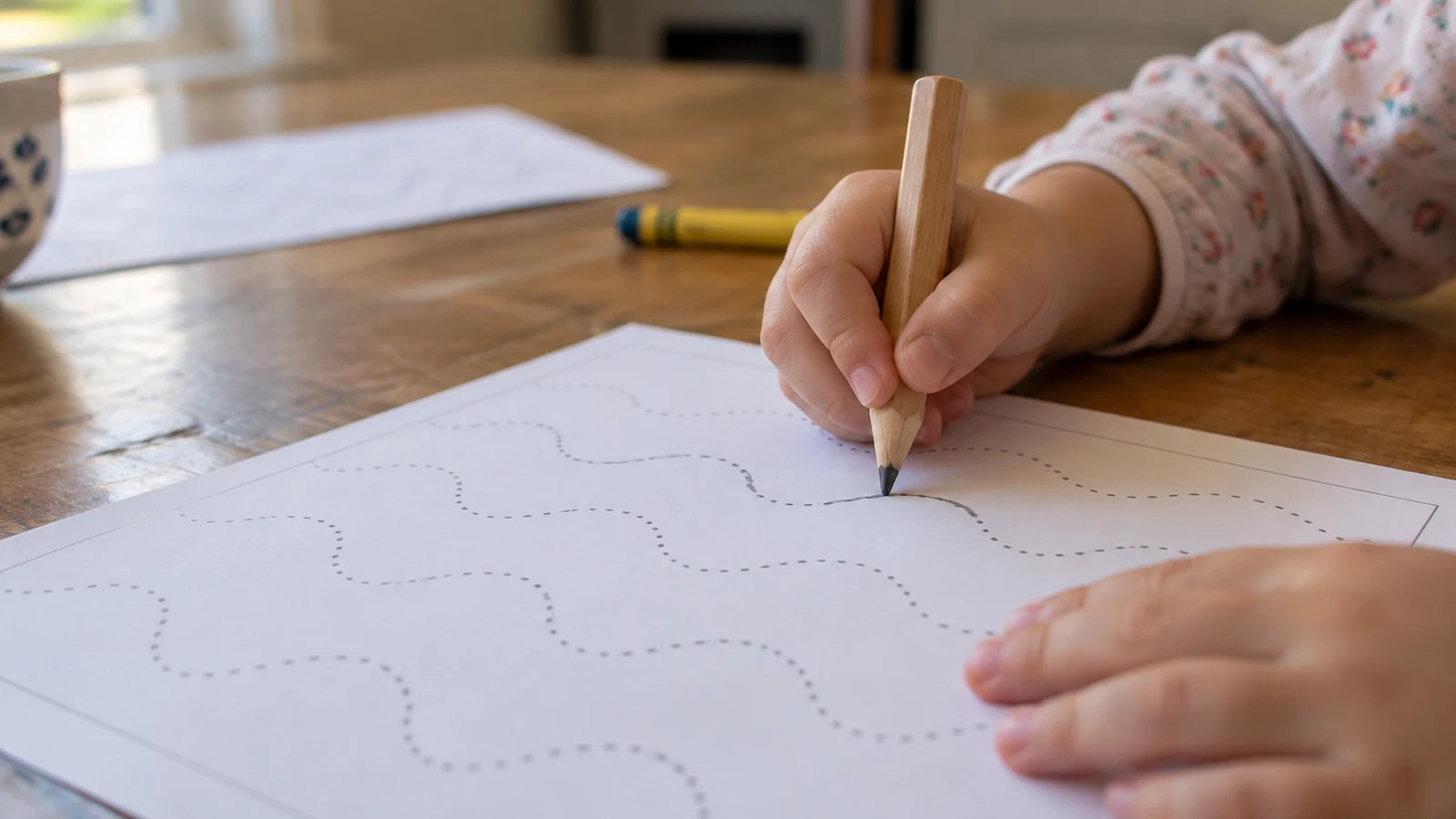
Start with paths rather than symbols. Nation1's tracing lines sheet includes straight, wavy, zigzag and curved paths, so you can change the movement without asking the child to remember a letter at the same time. A fresh sheet with different content appears with every click.
For a very new tracer, I would begin with the straight paths and keep the task small. One line across the page may be enough. If the pencil wanders off the path, that is information, not a failed worksheet. Try a wider movement with a crayon, shorten the session, or go back to a simpler path.
Wavy and curved lines can come next because the child has to keep changing direction without lifting the pencil. Zigzags ask for sharper turns. Honestly, I would rather see three controlled lines and a child who wants another turn tomorrow than a completed page produced with your hand wrapped around theirs.
Got a child who hates the pencil? Start with crayons on the line sheets. The goal at this stage is the movement, not a perfect school pencil grip.
Stage 2: move into circles, squares and triangles
Shapes give those line movements a destination. A circle asks for a continuous curve. A square uses straight lines with clear corners. A triangle brings in diagonals, which is one reason it can feel much harder even though the picture looks simple.
The shape tracing generator has circles, squares, triangles and other shapes. I would choose shapes based on what the child can already draw rather than trying to finish every shape on the page in order. A child who can trace circles comfortably but struggles with triangles is showing you exactly where to spend the next few short sessions.
The developmental sequence helps explain the gap. Circles appear around age 3, squares around 4 to 4 and a half, while triangles come around 5 to 5 and a half. Those are approximate ages, so do not turn them into deadlines. Use them as a reason not to treat every shape as equally easy.
Should you correct a lopsided square? I would point to the next corner and have another go rather than erase it repeatedly. Keep the hand moving forward.
Stage 3: trace capital letters before lowercase
Once the lines and the basic shapes feel familiar, move into letters. Occupational therapists generally teach capitals before lowercase because capital letters are the same height and start at the top. That removes some of the size decisions that lowercase writing brings.
The easiest capital letters are usually the straight-line group: L, F, E, H, T and I. Curved capitals such as C, O, Q and G can follow. I would leave the diagonal-heavy group, including A, V, W, X, K, M and N, until later. Look at an M through the eyes of a new writer and it stops looking simple.
Nation1's single letter tracing puts one letter on a sheet, which is the option I would pick first. Once several letters are familiar, the whole alphabet sheet makes more sense. The letters sit on primary handwriting lines, with a dashed midline at the real height of lowercase letters. Print uses the Andika font, and cursive uses Playwrite US Trad. You can choose gray or dotted letters.
Lowercase can follow the capitals once the child is handling the basic strokes without much strain. Do not feel obliged to move through A to Z just because the alphabet has that order. Pick letters whose movements fit what the child can already do.
Put number tracing alongside letter work
Numbers can sit beside letter practice rather than waiting for a separate stage. They use many of the same basic movements as the letters, mostly straight strokes and curves. I would introduce a small number set while the child is already comfortable tracing simple capital letters.
The Nation1 number tracing worksheet covers 0 to 20. There is no need to put all 21 numbers in front of a beginner at once. Work with a few, then change the sheet when those movements stop taking so much effort.
Some numbers will be easier than others for a particular child. That is fine. The order here is about keeping the physical demand sensible, not checking off every symbol on a schedule.
If 2 turns into a loose curve or 4 keeps losing a line, shorten the practice rather than drilling it for twenty minutes. Come back another day.
Stage 4: trace the child's own name
A name is wonderfully motivating because it belongs to the child, but I would not make it the first tracing task. A name can contain several hard movements at once. Ava gets diagonals immediately. William has repeated changes of direction. Chloe mixes a curve, straight strokes and lowercase forms.
Once the earlier stages are going reasonably well, use the name tracing sheet. Type any name and it repeats on every line in print or cursive. For a child still learning basic letter formation, I would choose print first.
You can also separate the name into easier pieces in ordinary practice. Trace the first letter for a few days, then add another familiar letter. There is no prize for tracing the whole name before the hand is ready.
Want the name to feel special without turning it into a test? Put one good attempt on the fridge and stop there. That can be enough for the day.
Keep sessions short and choose the pencil carefully
Five to 10 minutes a day is a better target than one long tracing session. Stop while the child still wants more. That sounds almost too simple, but it keeps the worksheet from becoming the part of the day both of you start avoiding.
Pencil grip is still settling between ages 4 and 6, often into a tripod or quadrupod grip. A short golf pencil or a triangular pencil makes a full fist grip harder to keep. I would use one of those before spending time repeatedly repositioning every finger.
Paper matters less than the task printed on it. Nation1 makes Letter-size PDFs directly in the browser, free and without sign-up, so print one sheet rather than ten. If it goes badly, change the movement next time instead of forcing the same page again.
Need more than individual letters later on? The handwriting worksheet generator puts words and sentences on handwriting lines. Save that for a child who is already comfortable forming the letters inside those words.
What I would skip at the beginning
I would skip full alphabet pages covered in tiny dotted letters for a child who is still fighting the basic strokes. They look productive because there is a lot to complete, but the child may spend most of the time repeating movements that are currently too hard. One letter, one line pattern or two shapes gives you much clearer feedback.
I would also skip coloring-page style worksheets where tracing is almost an afterthought. Coloring can be useful for its own reasons, but if your goal today is tracing, give the child something that actually has a path to follow. Keep the task obvious.
Scribbling is not a reason to print a harder page. If a child starts scribbling across every line, I would assume the session has run out of usefulness. Stop, or hand over blank paper and let the scribble be the activity.
What if the child simply refuses? Put the worksheet away. Try again with a crayon on a shorter path, and keep the next attempt brief. You are trying to build control without turning the paper into a daily argument.
Questions parents ask
What age should a child start tracing worksheets?
There is no single start age. For children around 3, simple lines and circles are a sensible place to begin if they are interested, while harder shapes and diagonal strokes often come later.
Should kids trace uppercase or lowercase letters first?
Start with capital letters. They are the same height and start at the top, and straight-line capitals such as L, F, E, H, T and I are good early choices.
How many tracing sheets should a child do each week?
Think in minutes rather than completed sheets. Five to 10 minutes a day works better than one long session, and you can stop before a sheet is finished if the child is losing interest.